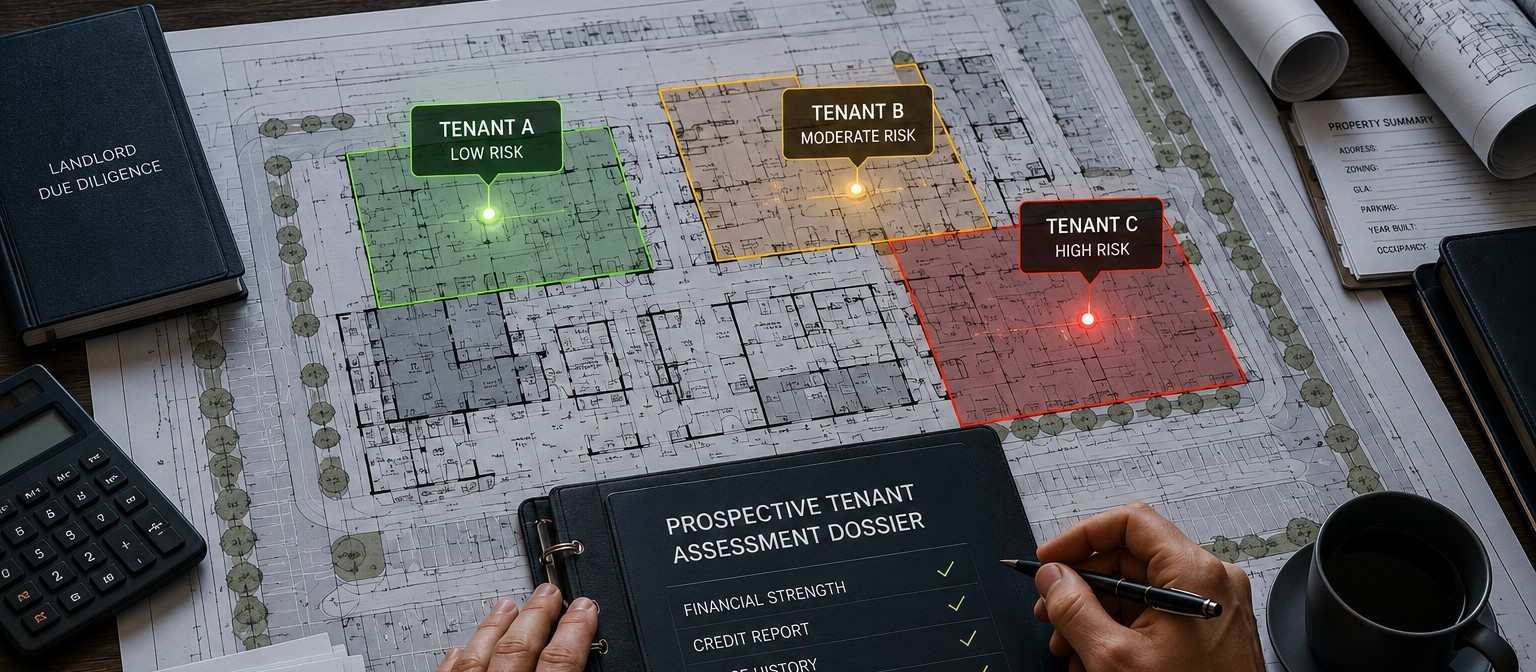
Self-Assessment
A credit check and a good feeling aren't a vetting process. This free audit runs the checks that actually predict whether a tenant pays and stays, before you sign.
A signed lease feels like the finish line. It isn't. The real test comes later: when rent is due during a slow month, when the tenant wants to assign the lease to someone you've never met, or when a default forces you to figure out, on short notice, how exposed you actually are.
Most of that risk is visible before you sign, if you know where to look. Commercial tenant screening, the actual due diligence behind who you are renting to, comes down to a few concrete things: financial strength, the entity actually signing, and what backs up the lease if the tenant cannot pay.
Answer the fifteen questions below honestly, based on what you actually know about this tenant today. Each unchecked item is a gap in what you know, or a risk you haven't covered off, before the lease is signed.
Answer honestly, based on what you currently know about this prospective tenant. Each unchecked item is a gap worth closing before you sign the lease.
If you felt even a moment of uncertainty answering these questions, that uncertainty is the answer. Most landlords who think carefully about this realize they have less visibility into a prospective tenant than they assumed, especially under time pressure to fill a vacancy. That is not a failure on your part, it is the natural result of leasing being a faster process than due diligence. But the time to close those gaps is before the lease is signed, not after the first missed payment.
A lease review starts with a conversation. Reach out to talk through this tenant, this lease, and what's worth addressing before you sign.
Schedule a Consultation →What's the single biggest predictor of whether a commercial tenant will default?
There's no single predictor, but financial strength of the actual signing entity is the closest thing to one. A tenant operating through a newly incorporated numbered company with no assets and no track record carries materially more risk than an established business, even if the people behind it seem credible. That's exactly why confirming the signing entity and its financial position matters more than a handshake impression.
Should I always require a personal guarantee from a corporate tenant?
Not always, but it should be a deliberate decision rather than a default. Personal guarantees matter most when the tenant entity is new, thinly capitalized, or the lease term and rent commitment are large relative to what the corporate tenant alone could cover. For established, well-capitalized tenants, landlords sometimes trade away the guarantee in exchange for other concessions. The point is knowing what you're giving up either way.
How much security deposit is reasonable for a commercial lease?
There's no fixed market number. It should scale with the risk the tenant actually represents: a longer track record and stronger financials justify less security, while a new business, a thin balance sheet, or a use that's hard to re-let after a default justify more. First and last month's rent is a common floor, not a ceiling.
What should I be looking for in assignment and subletting clauses before I sign a lease?
The core question is how much control you keep if this tenant wants to hand the space to someone else. Reasonable consent rights let you vet whoever takes over rather than being stuck with a tenant you never approved. Overly permissive language can let the original tenant walk away from a problem lease by assigning it to a weaker party, leaving you holding the risk.
What happens if a commercial tenant defaults partway through the lease?
What happens depends heavily on what the lease says and what security you took up front. A landlord with a properly drafted default and remedies clause, an appropriate deposit, and a personal guarantee where warranted has real options: drawing on security, pursuing the guarantor, and re-letting the space. A landlord without those protections is often left absorbing the loss while pursuing a judgment that may not be collectible.
Should I worry if a new tenant won't generate revenue right away?
It depends on how the rent gets paid during that ramp-up period. A tenant with a build-out or licensing process ahead of them may go months without revenue, and if rent is due in full from day one, that gap has to come from somewhere, whether that's their own capital reserves or a guarantor. Ask directly how they plan to cover rent before the business is actually generating money, rather than assuming it will work itself out.
Is a franchise tenant lower risk than an independent business?
Not automatically. A franchise brand can lend credibility, but in most structures the franchisee, not the franchisor, is the entity signing your lease and is the one you're actually relying on financially. Check whether the franchisor has any guarantee or backing obligations in the franchise agreement, because in most cases there are none, and you're assessing the franchisee's standalone strength regardless of the brand on the sign.
Does it matter if a tenant's use overlaps with my other tenants?
Yes, in two directions. First, check your existing leases for exclusivity clauses you may have already granted, since a new tenant whose use conflicts with one of those can expose you to a claim from the existing tenant. Second, consider whether the use fits the building's zoning and tenant mix generally. A use that's technically permitted but a poor fit for the building can create friction that outlasts the lease negotiation itself.
Does a tenant's lack of experience in this type of space matter if their financials look fine?
It's a different kind of risk than financial strength, but it's still worth weighing. A tenant opening their first location in a format they've never operated before is making more operational assumptions than one with a proven track record in similar space. Strong financials reduce the risk of a payment default, but they don't guarantee the business itself will work in this location, which matters for re-leasing risk if it doesn't.
How is Forgione Deal and Corporate Counsel different from a large firm for commercial leasing work?
Wes Forgione reviews and negotiates leases personally, for landlords assessing a prospective tenant and for tenants reviewing what they're being asked to sign. Clients get direct access to the lawyer doing the work, backed by the perspective of having closed upwards of 400 transactions.
Important: This is a self-scoring audit intended to give general guidance, not legal advice. It reflects general information current to July 20, 2026, and it is not legal, tax, accounting, insurance, or investment advice. It doesn't replace advice about your specific situation, and completing it doesn't create a lawyer-client relationship. Laws, government rules, and tax rates can change, and how they apply depends heavily on the facts. Talk to a qualified Ontario lawyer and tax professional before signing a commercial lease or approving a new tenant.